



That gray or reddish film coating your wheels after a week of driving looks like ordinary road grime, so most drivers treat it that way. It isn’t. Brake dust is a byproduct of your braking system wearing down, and left alone, it does something ordinary dirt never does: it starts eating into the wheel underneath it.
At BLISS Car Wash, wheel care isn’t an afterthought tacked onto the wash. Our packages include dedicated wheel cleaning products built specifically to break down brake dust safely, without scratching or dulling the finish underneath.
What Brake Dust Actually Is Made Of
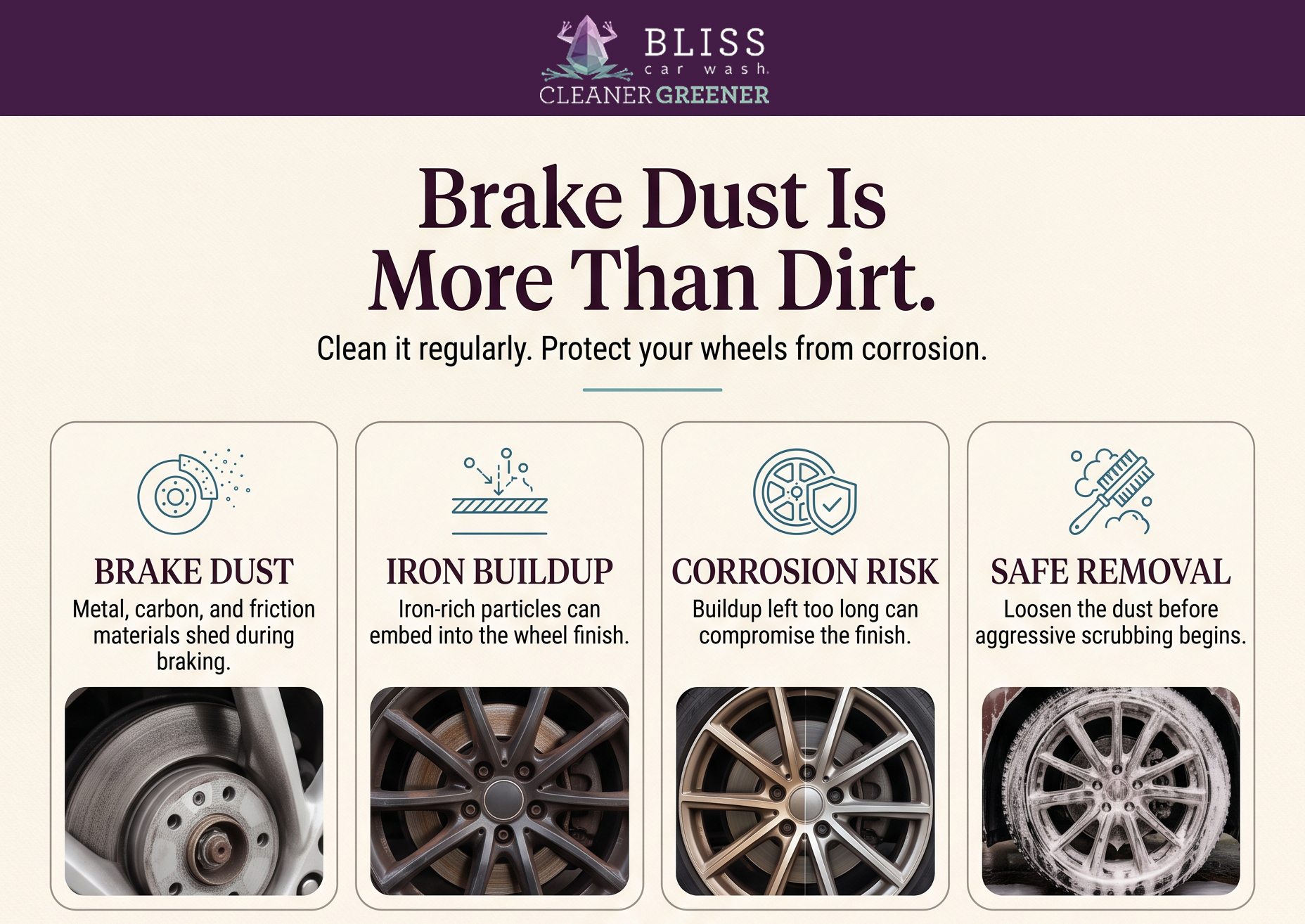
Every time you brake, friction wears tiny particles off the pads and rotors. Those particles are a mix of metal, carbon, and other friction materials, and depending on your brake components, they can carry a significant amount of iron.
That composition matters because it’s the reason brake dust behaves so differently from mud or pollen. It isn’t just sitting on the surface of your wheel, it’s chemically primed to react with it.
Brake Dust Isn’t Just Iron
It’s tempting to think of brake dust as simple iron scraped off the rotor, but that description undersells how chemically complex brake wear actually is. Understanding the fuller picture explains why cleaning it properly takes more than a quick rinse.
What’s Actually in the Particles
A 2026 study published in Atmospheric Research found that brake wear particles were roughly 85 percent inorganic and 15 percent organic material, with iron, oxygen, and carbon as the predominant elements, alongside smaller amounts of copper, titanium, and barium. The full study on brake wear particle composition also identified iron oxides including magnetite and hematite, showing the particles carry more than bare metallic iron.
Confirmed in Real-World Driving
Lab findings hold up on the road too. A 2025 study that tracked a light duty vehicle under actual driving conditions found iron was the most abundant metallic element in the collected brake particles, followed by copper, aluminum, and zinc, with iron linked primarily to the brake disc and copper and aluminum tied more closely to the brake pad material, according to the real world vehicle emissions study.
That composition can shift depending on your specific brake materials and driving conditions, which is exactly why treating brake dust as a single, uniform contaminant misses the point. It’s a mixture generated by several parts of the braking system working together, and dedicated wheel cleaners are formulated with that complexity in mind rather than simply targeting metal.
Why Brake Dust Is More Than Just Dirt
How Iron Particles Attack the Finish
Most modern wheels are made from aluminum alloy, which doesn’t rust on its own the way steel does. According to wheel manufacturer Wheel Pros, the rust colored spots drivers see on alloy wheels typically come from extended exposure to brake dust, since the iron particles it contains can become embedded in the wheel’s clear coat and expand over time as they sit there. Left long enough, that expansion compromises the protective coating, and once that happens, the damage is generally permanent.
Different Wheel Finishes, Different Risks
Not every wheel reacts to brake dust the same way. Painted and clear coated wheels are vulnerable to the metallic compounds in brake dust tarnishing the finish, while Family Handyman notes that those same compounds can etch steel, alloy, aluminum, and composite wheels if allowed to build up, and can even corrode wheel stud threads over time. That’s a meaningful detail, since the risk isn’t limited to how your wheels look. Corrosion that reaches the hardware underneath can eventually make routine maintenance, like changing a flat tire, more difficult than it should be.
The Safe Way to Remove Brake Dust
What to Avoid
It’s tempting to reach for whatever’s on hand, but harsh household cleaners or high acid wheel sprays can do as much damage as the dust itself, especially on painted or clear coated finishes. Scrubbing dry brake dust with a dry cloth is another common mistake, since the abrasive particles can scratch the surface before any cleaner even gets involved.
What Actually Works
The safer approach starts with a dedicated wheel cleaner formulated to break down the metallic bond before you ever touch the surface with a brush. Rinsing thoroughly first loosens the surface layer, letting the cleaner do the harder work of lifting embedded particles rather than grinding them further into the finish. Frequency matters here more than intensity, since brake dust that’s cleaned regularly never gets the chance to bond as tightly as dust that’s left to accumulate for weeks at a time.
How BLISS Car Wash Cleans Wheels Safely
We built wheel care into the wash itself instead of treating it as an upsell. Our Wheel Brightener formula penetrates and loosens road soil and brake dust on all types of wheel and tire surfaces, using a foaming action that provides complete coverage without requiring aggressive scrubbing.
Paired with our Tire Scrubbers, which aggressively clean asphalt oils, road film, brake dust, oil, and grease while remaining safe on aluminum and alloy wheels, and our undercarriage wash, which removes the buildup of dirt, chlorides, and grime that collects underneath the car, the goal is coverage that goes beyond what’s visible from the outside. Brake dust doesn’t stay confined to the parts of the wheel you can see, so neither does our cleaning process.
Keeping Corrosion From Starting in the First Place
The single biggest factor in preventing brake dust corrosion isn’t the product you use, it’s how often you use it. Wheels that go weeks between cleanings give iron particles time to bond and expand, while wheels cleaned on a regular schedule rarely reach that point at all.
Driving habits play a role too. Stop and go traffic and frequent braking generate more dust than highway driving, so if your daily commute involves a lot of both, your wheels are accumulating buildup faster than you might expect. Either way, the fix is the same: consistent cleaning before dust has the chance to settle in.
Making Wheel Care Part of Your Routine
A BLISS Unlimited Membership turns that consistency into something automatic rather than something you have to remember. Instead of noticing brake dust buildup weeks in and scrambling to address it, regular visits keep your wheels clean before corrosion ever has the opportunity to start.
That’s really the difference between wheels that stay bright for years and wheels that develop pitting, discoloration, or permanent staining. It isn’t about finding one powerful cleaning session, it’s about not letting the buildup happen in the first place.
Protecting the Investment You Don’t Always Notice
Wheels are one of the more expensive parts of a car to replace or refinish, yet they’re often the last thing drivers think about between washes. Treating brake dust removal as routine maintenance, rather than an occasional deep clean, is what actually protects that investment over time.
If your wheels have started showing dullness, discoloration, or a film that doesn’t rinse off easily, it’s worth having them properly cleaned before that buildup turns into something permanent. Find your nearest BLISS Car Wash location and see what a wash built around real wheel care can do.
Frequently Asked Questions
What exactly is brake dust made of?
Brake dust is a mix of metal, carbon, and other friction materials that wear off your brake pads and rotors every time you brake. Research shows the particles are mostly inorganic material, dominated by iron, oxygen, and carbon, along with smaller amounts of copper, titanium, and other metals depending on your brake components.
Can brake dust actually damage my wheels?
Yes. The iron particles in brake dust can become embedded in a wheel’s clear coat and expand over time, which can compromise the protective finish and lead to permanent pitting or discoloration if left unaddressed.
Is all brake dust the same?
No. Studies of brake wear particles have found that composition varies depending on brake materials and driving conditions, with iron typically linked to the brake disc while copper and aluminum are tied more closely to the brake pad. This is part of why dedicated wheel cleaners are formulated to handle a mixture of contaminants rather than just metal.
How often should I clean brake dust off my wheels?
Cleaning wheels regularly, rather than waiting until buildup is visible, is the most effective way to prevent corrosion, since brake dust does more damage the longer it sits on the surface. Drivers who do a lot of stop and go driving tend to need more frequent attention than those who mostly drive highway miles.
Is it safe to use any wheel cleaner on my car?
Not necessarily. Harsh or highly acidic cleaners can damage certain wheel finishes, which is why using a product formulated for your specific wheel type matters as much as how often you clean.
What does BLISS use to remove brake dust safely?
BLISS uses a dedicated Wheel Brightener that penetrates and loosens road soil and brake dust, paired with Tire Scrubbers that clean aggressively while remaining safe on aluminum and alloy wheels. Both are included as part of our regular wash packages rather than offered as a separate service.
Why do my wheels look rusty if they’re made of aluminum?
Aluminum alloy doesn’t rust on its own, but the reddish spots often seen on aluminum wheels usually come from brake dust containing iron that has settled and reacted on the surface. Over time, those particles can create the appearance of rust even though the wheel itself isn’t rusting.