


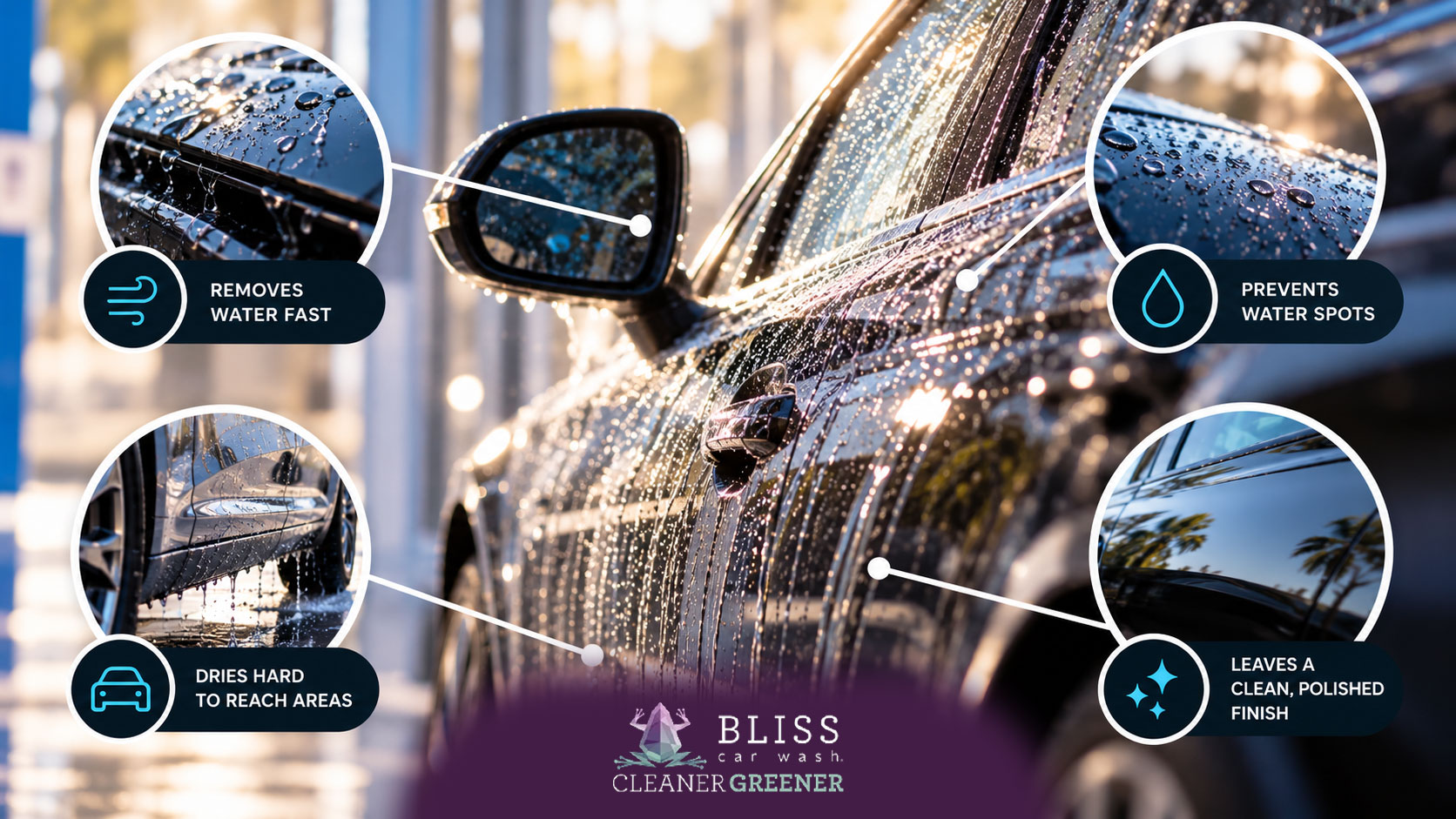
Right before your car exits the wash tunnel, it passes through a section that sounds like a small storm. Powerful blasts of air sweep across the hood, doors, and windshield, and by the time your car rolls out the other side, it is dry. That final stage is doing more precise, physics-driven work than it might seem, and it plays a real role in whether your car leaves the tunnel looking finished or streaked.
At BLISS Car Wash, that drying stage is handled by Air Blowers built around the same principles that shape drying technology across the car wash industry, paired with equipment designed to work efficiently without wasting energy.
Air Blowers vs. Compressed Air: What Actually Dries Your Car
The term compressed air gets used loosely to describe car wash drying, but it is worth clarifying what is actually happening. True compressed air, the kind used in a shop air compressor, stores air under pressure in a tank and releases it through a small nozzle. That is not how the drying stage in a wash tunnel works.
At BLISS, the drying stage uses Air Blowers. Compressed air is something you will find at the vacuum stations at some BLISS locations, where it helps blow air out of the crevices inside your car.
High Velocity Airflow, Not Stored Pressure
Car wash tunnels rely on high velocity Air Blowers, typically centrifugal blowers driven by powerful electric motors, that move a continuous, high volume stream of air rather than releasing stored pressure. These blowers are positioned along the exit of the tunnel and aimed to sweep water off the vehicle as it passes through, using volume and speed rather than compressed storage.
Why the Distinction Matters
Understanding this difference helps explain why drying performance depends on blower design and placement rather than a single powerful burst of air. A wash tunnel is not blasting your car with a jet of compressed gas. It is moving a large, continuous volume of air across the surface in a specific pattern designed to strip water away efficiently.
Airflow Volume, Velocity, and Pressure Are Not the Same Thing
An Air Blower can be described as powerful, but that word alone does not tell you much about how effectively it will remove water. Volume, velocity, and pressure describe different aspects of a blower system, and a strong showing in one does not guarantee strong performance overall.
Breaking Down the Terms
Air volume is the amount of air a blower moves and determines how much of the vehicle can be covered at once. Velocity is the speed of that moving air, which generates the force needed to actually displace water sitting on the surface. Pressure describes the difference driving that air through ducts and outlets in the first place, and nozzle design determines where and how concentrated the airflow ends up once it leaves the system.
| Factor | What It Controls | Why It Matters |
|---|---|---|
| Air volume | Amount of air moved | Determines how much of the vehicle can be covered |
| Air velocity | Speed of the moving air | Generates the force needed to displace water |
| Pressure | Pressure difference driving airflow | Influences how air moves through ducts and outlets |
| Nozzle design | Direction and concentration | Determines where airflow actually reaches the vehicle |
Why Velocity at the Surface Is the Real Test
For car wash drying specifically, velocity at the vehicle’s surface matters more than raw volume alone. A peer-reviewed engineering study on car wash dryer design, published in the Journal of Computational Design and Engineering, found that airflow velocity and its distribution across a vehicle directly influence the shear forces responsible for detaching water droplets from painted surfaces. The same research found that changing a dryer’s nozzle geometry could redirect airflow toward areas that were otherwise difficult to dry, and that redesigned systems performed measurably better when validated against real vehicle testing.
Why a Bigger Blower Is Not Automatically Better
That research points to a practical conclusion: installing a larger blower does not automatically produce a better dry. A system can move a substantial volume of air, but if its outlets are poorly positioned, that airflow can pass by the vehicle entirely or push water into areas that are harder to dry, undoing the benefit of the extra power.
How Airflow Physics Determines a Good Dry
Getting a car fully dry is not just a matter of pointing powerful blowers at it and hoping for the best. According to industry guidance published by Professional Carwashing & Detailing, airflow follows a straight line path once it leaves the ductwork, broadening gradually, until it reaches the widest point of the vehicle, where that straight path gets deflected away from the lower, tapered sections of the car.
Why Nozzle Angle Matters
That physics is why nozzle angle is not arbitrary. Air aimed at the top of a vehicle needs to flow along the surface toward the widest point, and airflow directed at vertical surfaces like doors needs a slightly downward angle to strip moisture in the same direction gravity is already pulling it. Getting that angle wrong means water gets pushed around rather than actually removed.
Sequencing the Dry
Effective drying also follows a top-down sequence. Stripping moisture from the roof and hood first, then the sides, mirrors the way water naturally wants to move under gravity. A blower system that fights against that natural flow, rather than working with it, ends up leaving more water behind than one that follows the vehicle’s actual shape and moisture pattern.
Why Blower Design and Positioning Matter
Not all blower setups are equally effective, and the difference often comes down to design details that are easy to overlook. Modern blower systems used across the car wash industry are built to be contoured to the shape of a vehicle and positioned to output strong airflow while running on far less horsepower than older, less efficient designs.
Fewer Blowers, Better Results
Better blower design can actually mean fewer total units are needed to achieve the same drying result, since well-positioned, well-shaped blowers do more work with less wasted airflow. That efficiency has a real impact on both the energy a wash tunnel consumes and the physical space its drying section requires.
Positioning Along the Tunnel
Blowers are also typically staged at multiple points and angles along the tunnel exit, rather than concentrated in one spot, so that different parts of the vehicle get targeted airflow as they pass through. A single blast from one direction cannot account for the shape variation between a sedan’s roofline and an SUV’s higher, boxier profile, which is why staged, multi-angle blower systems have become standard.
The BLISS Approach: DRY N’ SHINE and Efficient Equipment
BLISS applies these same principles through its DRY N’ SHINE brushes and energy-efficient Air Blowers, which work together at the end of the wash tunnel to finish the job the foam brush wash and spot-free rinse started.
Combining Brushes and Airflow
Pairing physical drying brushes with airflow is a deliberate choice, not a redundancy. The brushes help lift and absorb water directly off the surface, while the Air Blowers handle areas the brushes cannot reach as effectively, like mirrors, door seams, and other tighter contours. Together, they cover more of the vehicle’s surface than either method would on its own.
Energy Efficiency as Part of the Design
BLISS’s broader commitment to energy-efficient equipment extends to its drying stage. That focus on efficiency is consistent with the same water saving technology and eco-friendly approach found throughout the rest of the BLISS wash process, rather than being treated as a separate concern from the wash itself.
What This Means for Your Car
A well designed drying stage does more than make your car look finished when it leaves the tunnel. It protects the results of everything that happened earlier in the wash.
Locking In the Spot Free Rinse
Earlier in the process, BLISS’s NuWave Industries reverse osmosis system treats the final rinse water to prevent mineral spotting. That treatment only pays off if the drying stage actually removes the water efficiently before it has a chance to sit and evaporate unevenly. A strong, well-angled drying stage is what carries that spot-free result all the way to your driveway.
Reducing Streaks and Residue
Water left behind after a poor dry does not just risk spotting. It can also leave streaks on glass and body panels that make a wash look incomplete even when the cleaning itself was thorough. A properly executed drying stage is often the difference between a wash that looks merely clean and one that looks genuinely finished.
Setting Up the Polish Tunnel
At BLISS locations with a Polish Tunnel, customers using the Transform+ package get even more from a well-dried vehicle, since it sets up better results for the hand applied polishing wax and microfiber buffing that follow. Excess moisture left on the surface can interfere with how evenly that wax gets applied and buffed in.
Every Detail Adds Up at BLISS
The airflow at the end of a BLISS wash tunnel is not just a final blast to send your car on its way. It is a carefully positioned system of Air Blowers built around real airflow physics, working alongside DRY N’ SHINE brushes and efficient equipment to lock in the results of the rest of your wash.
Ready to experience it for yourself? Visit BLISS Car Wash to find a location near you and see how every stage of the process works together.
Frequently Asked Questions
Does a car wash tunnel use compressed air to dry cars?
No. The drying stage in a wash tunnel uses Air Blowers, which move a continuous, high velocity stream of air rather than storing and releasing pressurized air the way a shop air compressor does. At BLISS, compressed air is found at the vacuum stations at some locations, where it is used to blow air out of the crevices inside your car.
What is the difference between air volume, velocity, and pressure in an Air Blower?
Volume is how much air a blower moves, velocity is how fast that air travels, and pressure is the difference that drives airflow through the system. All three need to work together, along with good nozzle design, for effective drying.
Why does the angle of the airflow matter for drying a car?
Airflow follows a straight line path that broadens until it reaches the widest point of a vehicle, where it deflects away from lower, tapered sections. Correct nozzle angles work with that natural airflow pattern instead of against it, which is essential for a thorough dry.
Does a bigger, more powerful blower always dry a car better?
Not necessarily. Research on car wash dryer design has found that nozzle geometry and airflow distribution matter as much as raw power, since poorly positioned outlets can send airflow past the vehicle or leave certain areas harder to dry.
What does BLISS use to dry cars after a wash?
BLISS uses DRY N’ SHINE brushes alongside energy-efficient Air Blowers, combining physical drying with airflow to cover more of the vehicle’s surface than either method alone.
Why does drying matter if BLISS already uses a spot-free rinse?
The spot-free rinse only prevents mineral spotting if the water is actually removed efficiently afterward. A strong, well-designed drying stage is what carries that spot-free result through to when you get home.
Does drying affect how well the Polish Tunnel wax gets applied?
Yes. Excess moisture left on the surface can interfere with how evenly polishing wax gets applied and buffed in, so a well-dried vehicle sets up better results in the Polish Tunnel, available at select BLISS locations.